aquarius♒︎lab
Aquarius: Exact Reading and Writing
in a Closed Circulation
Abstract
One closed circulation of water runs through this paper, from the heat that turns it to what a single return reads and writes, and one constant of the vessel’s shape governs both. Inside a closed ellipsoid of equatorial radius , the circulation with streamfunction solves the steady incompressible Euler and Navier–Stokes momentum equations at every viscosity , while its midplane pressure takes its minimum on the ring that splits the midplane into equal areas. At uniform susceptibility a static magnetic field sets the interior pressure, and for axisymmetric profiles crossed gradients of thermal susceptibility and magnetic energy drive vorticity directly along the circulation’s own axis. Twelve coupled vessels on a ring split as , the table of modes and elements of the twelve signs, and wherever three branches meet a junction holds the carry trit , which one scalar bias reads as or . The field sets that bias, so one network of junctions with fixed wiring computes every Boolean function of its inputs, its program held in the field. With controlled swaps on the same wiring, the network permutes its wires, reads its program and erases nothing; two vessels joined by one channel, their modes tuned three to two, exchange their states exactly, so the open or closed channel is the control. Each wire held in a pair of vessels, the whole network runs in the water: open channels exchange two wires, the root pair carries the answer, the vessels keep their energy and the stages run backward to the start. Two guides sharing one compliant wall split every harmonic three to two, so one wall and one clock run the network on every odd harmonic at once; pressure at the boundary writes one phase on light, and the discrete Fourier transform returns every channel exactly. Positive couplings at distances one, three and five join the twelve vessels on the ring: every mode turns at an odd harmonic, and one opening exchanges all twelve. Where a boundary writes a phase of , light crossing it goes dark along the seam at every depth, and media sharing one quotient compute one map; switched while every vessel is at rest, the walls do no work. All of it composes into one factorization, , under which the main theorems of eleven of the author’s sixteen earlier papers fall as instances of Theorem A0 and its bridge laws. On every interior stream surface () the shape constant is , determined by the aspect ratio and the shell alone: the return angle reads a relation among three phases that no pair of modes carries, a small torsion turns independent phases into a relation among three modes written in the shifted amplitudes, and at constant inertia and both leading channels go silent. The theorems are machine-checked in Lean 4 with Mathlib, and their analytic parts, among them the elliptic form of the period in Theorem A3 and the uniform remainder bounds of Theorem A12(a), are proved in the text.
1 The return and its contraction
We must think of it as a river flowing up and down in a circle and made up partly of air, partly of water. […] So if ‘Oceanus’ had some secret meaning in early writers, perhaps they may have meant this river that flows in a circle about the earth.
Aristotle, Meteorologica I.9 [2]
Aristotle is describing rain. Heat draws the water up as vapour and cold brings it down again, and in this circle, he says, the order of the sequence always remains the same; in the Preface to the Phenomenology, Hegel calls the true the whole, the circle that presupposes its end as its goal and has its end for its beginning [21]. Aristotle thought the early writers had already named that circle, and that their Oceanus was this river.
Aquarius is another old name for it. It belongs to the signs of air, which Aristotle held to be hot and moist, “a sort of aqueous vapour” [3], while its figure carries water, making the sign air carrying water, the same river held in one image. Its oldest form is the Babylonian GU.LA, the Great One, the god Ea holding a vase that overflows [58], and Ea was the god of the fresh water beneath the earth and of wisdom [6], the water and the knowledge in one figure from the start. Its glyph is two waves, one above the other, and the age that carries its name is read as the one in which that water is poured out for everyone.
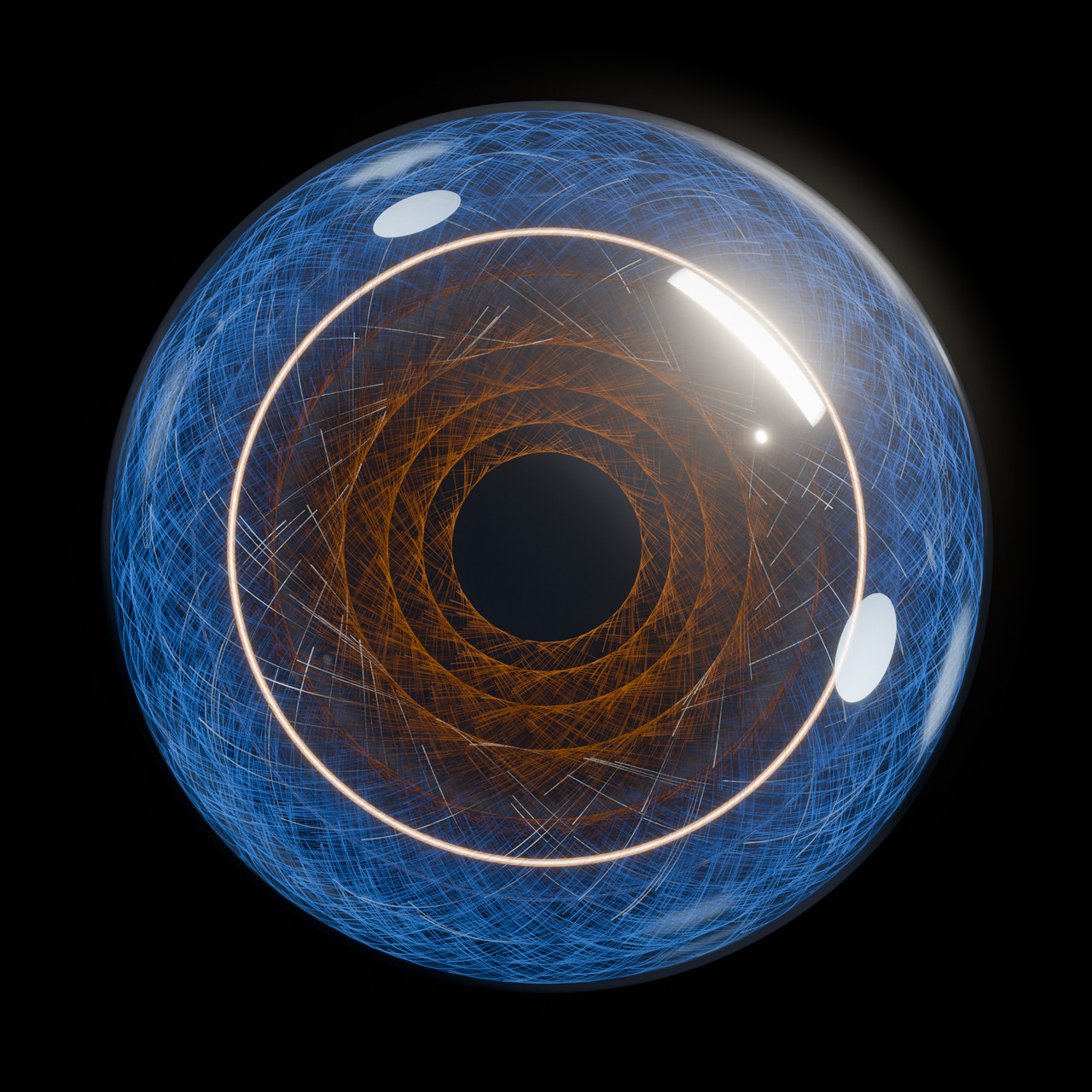
The twelve signs of the zodiac form a table of three modes and four elements in which no two signs share both, and that table is the residue split of Theorem A0(d). Counting Aries as zero, Aquarius stands at ten, fixed and air, the pair , and gives it back. The same split carries the ring of twelve vessels in Section 4 to the trit of Section 5.
Sixteen papers before this one kept returning to the same question: when a large carrier evolves under a simple law, what does an observation keep of it? Each time, a small boundary appeared through which everything downstream factors. An ordered decision keeps one of three states [46], thirty-two additions sharing an input keep at most thirty-three carry states across a cut [40], and every preimage of a cyclic Boolean–modular map is fixed by its first three bits [33]. Theorem A0 states that contraction once for any flow, and Appendix A gathers the main theorems of eleven of those sixteen papers directly under it and its bridge laws, alongside five that stand in an explicit relation to it. Now we put the same question to a moving fluid: what does a closed circulation keep?
Write every computation in this paper as one transformation,
Here is the state space of a geometry, is its evolution, prepares an initial, boundary or spectral configuration from an input in , and observes it. The geometry carries the state, and its evolution is the computation. A finite state machine, a carry trit and a one-bit gate are all contractions of that evolved geometry, some exact and some coarse, so what the computation carries forward is whatever can tell apart along the flow; the distinction itself is the primitive. Reinhold set one act of distinction at the root in his principle of consciousness, where the representation is distinguished by the subject from subject and object and related to both [57].
Quotienting a carrier by what an observation can tell apart runs across four traditions: it gives Nerode’s minimal automaton [53], the observable part of a linear system in Kalman’s canonical decomposition [24], a lumpable Markov chain [27], and symmetry reduction for a flow [49]. Kant set the thing as it is in itself apart from the thing as it appears; only the appearance, shaped by the observer’s own forms, is received [25]. Theorem A0 formulates that quotient once for a flow semigroup and its iterates, setting up the exact contractions used through every section that follows.
Definition 1.1 (Flow semigroup and equivariant contraction).
Let be a set. A one-parameter family is a flow semigroup when and for all and . For a single-step map , its discrete iterates are and (). A surjection has -invariant kernel when implies , and is flow-equivariant with respect to when for every .
Following [46, Section 2], a family of observations induces the observation equivalence . A map is a retained boundary when , and exact when the converse holds as well.
Theorem A0 (The contraction of a flow).
Let be a state space, , , and a surjective map.
-
(a)
For any map , there exists a reduced map satisfying if and only if has -invariant kernel. When exists, it is unique and satisfies for every .
-
(b)
If is a flow semigroup on and for every , then is a flow semigroup on . Whenever for some , setting contracts (1) at every horizon :
(2) -
(c)
For any observation family on , every finite retained boundary bounds the quotient by , and every surjective exact boundary determines a unique bijection with .
-
(d)
On the twelve-tick cyclic dial , Mordell’s identity
(3)induces the bijection , , with inverse . For any , , and angular reading with , the rounded gauge recovers ; reading through therefore tolerates uniform phase error per channel, three times the of the undivided twelve-state dial.
Proof.
(a) If and , then . Conversely, assume is -invariant. Because is surjective, each has a chosen preimage with . Put . For any , , so kernel invariance gives . If , surjectivity of gives . Induction on gives and .
(b) Given , , and for all ,
When , .
(c) Sending to is well defined because is a retained boundary, and surjective because is surjective; hence . When is exact and surjective, this map is defined on all of and is injective because ; uniqueness follows from surjectivity of .
(d) Write : since and , is congruent to modulo (as and ) and modulo (as and ), hence modulo . Since , supplies the exact inverse on . Finally, multiplies by to , or , so . With and the two channels decode below and , so every error below is read exactly on both. ∎ □
Under the twelve signs, numbered from Aries at to Pisces at , split directly into their modes and elements: cardinal, fixed and mutable are , and fire, earth, air and water are . In binary, is Aristotle’s pair of qualities [3]. Its low bit alternates hot and cold from sign to sign, and its high bit, flipped by the carry out of the low bit, alternates dry and moist every second sign.
The chain
Sections 2 to 8 trace one chain,
and each arrow carries its full hypotheses into the theorem that proves it. Section 2 builds the vessel and its circulation; Section 3 turns the water with heat and sets the pressure with the field; Section 4 puts twelve vessels on a ring; Section 5 finds the trit where three branches meet; Section 6 composes the arrows into one theorem; Section 7 follows a single turn of the water to the constant that reads and writes; and Section 8 writes the program into the field, so one fixed network computes every function.
2 The vessel
Let , put , and define the closed ellipsoid
Write , , , , , and , so that and . Let reflect across the equatorial plane . Extending Theorem W5 of [47] to , every scalar field splits uniquely into a mirror-even drive and a mirror-odd torsion , vanishing across the midplane as . Under the upper and lower sheets trade places, the Emerald Tablet’s “as above, so below” [60].
Theorem A1 (The circulation and its two sheets).
Define the normalized streamfunction and Stokes streamfunction . The resulting Cartesian mass-flux field
satisfies on all of , so that outward normal flux vanishes everywhere on , and . Under the reflection , the field obeys .
Proof.
For , and , whose Cartesian lift is the polynomial vector field (6) on all of . Direct differentiation gives
Since ,
which vanishes when . Using and ,
Replacing by negates and while preserving , yielding the reflection law. ∎ □
Theorem A2 (The ring of equal areas).
Across the equatorial disc , the normalized cumulative vertical transfer inside squared normalized radius is . The vertical flux vanishes only at (), dividing into an inner disc and an outer annulus of equal area carrying balanced upward and downward transfers
Among all vector fields on of the form with arbitrary , boundary tangency on forces for every .
Proof.
In polar coordinates on , , so the cumulative flux through radius is . Clearly , with and , giving (7); the two regions occupy , hence area each. For uniqueness, . Requiring whenever (or by continuity from on to ), choose for any : then , so , whence . ∎ □
In the continuum, (7) is the seam dipole of [47, Theorem W6]. The inner disc forms the upward source , and the outer annulus carries its return field, the sink .
Theorem A3 (Each turn contracts to a circle).
Proof.
For , . Substituting into completes the square to , and , proving strict interior enclosure. Differentiating along and gives
Along , the chain rule with gives and , matching the meridional ODE identically. Since , one revolution takes normalized time . By symmetry on and , substituting () gives with , yielding (9). ∎ □
Hill introduced a spherical Euler vortex in 1894 [22], recorded in Lamb [30], and O’Brien generalized it to viscous spheroids [55], surveyed by Wang [66]. The velocity of Theorem A1 realizes that family at arbitrary aspect ratio and every viscosity , with the wall a stream surface along which the water slides: the velocity never depends on , and viscosity enters the pressure only as a term linear in height.
Theorem A4 (Every ellipsoid, every viscosity).
For all , all , and every dynamic viscosity , the velocity field has convective acceleration
and solves the steady three-dimensional incompressible Navier–Stokes momentum equation
throughout with interior pressure
When , the midplane pressure takes its strict global minimum on the equal-area split circle (). Its vorticity is harmonic, , and obeys .
Proof.
Computing the velocity Jacobian gives , , , , , , and . Thus
and symmetrically for , establishing (10). Second partial derivatives of all vanish, while . Differentiating (12) using and yields
proving (11). At ,
for every when and . Finally, . Because is linear in and independent of , , while , since . ∎ □
With a swirl constant in height, the motion on every interior stream surface conjugates to a Kronecker flow on a torus, and the water closes back on itself if and only if the swirl rate and meridional period are commensurate, .
Theorem A5 (Two clocks on a torus).
For any constant normalized swirl rate , the normalized vector field
satisfies , , and , and leaves the midplane transfers (7) unchanged. When and , the projected logarithmic spiral slope is , reversing under . On each shell , the rectified meridional angle conjugates the nonlinear flow of through Theorem A0 to the linear Kronecker flow on . Its equatorial Poincaré return map closes after meridional periods if and only if .
Proof.
The rotational perturbation is divergence-free, has zero -component (leaving unchanged), and is orthogonal to , hence preserves , , and . With , , and , giving . Along , , establishing the exact conjugation to . After meridional cycles (), returns to , while returns modulo if and only if for some , which is equivalent to . ∎ □
3 Heat turns the water
Heat enters along the first arrow of (4), alongside a magnetic field acting in two ways. At uniform susceptibility its Kelvin force [59] is a gradient, setting scalar pressure without disturbing vorticity and supplying the junction bias for or (Theorem A6). When susceptibility varies with temperature, crossed gradients of temperature and magnetic energy give the Kelvin force a curl, driving thermomagnetic convection [17]; for axisymmetric profiles that curl aligns with the circulation’s vorticity and turns the water (Theorem A7). Schelling saw nature moved by opposed forces: nature is visible spirit and spirit invisible nature [61]. Any two-bath cycle of positive affinity [63] delivers its work inside the Carnot bound.
Theorem A6 (The field sets the pressure).
Let be a squared magnetic-flux density on , with and spatially constant magnetic susceptibility . The Kelvin body force is curl-free, . Acting on an isothermal homogeneous fluid, the static magnetic field preserves the velocity and bulk vorticity of the Navier–Stokes closure (11) while setting its scalar pressure to .
Proof.
Because , mixed partial derivatives commute (, etc.), and constancy of gives , and identically for . Adding to the right-hand side of (11) absorbs directly into . ∎ □
Theorem A7 (Heat crossed with the field).
Let be a thermally (or compositionally) stratified susceptibility and a magnetic energy scalar.
- (a)
-
(b)
For any quantized or continuum two-bath thermodynamic cycle exchanging energy increments with a hot bath at and with a cold bath at to deliver modal work , -cycle conservation reads (). Positive cycle affinity holds if and only if , which gives the strict Carnot bound
(16)
Proof.
(a) By the product rule and symmetry of second partials of ,
with , and cyclic permutation gives (14). When and , and similarly for . Their cross product has -component , -component , and -component , dividing by to yield (15).
(b) Distributivity gives . Since , . Dividing by gives , so . ∎ □
An azimuthal Lorentz force stays orthogonal to , driving swirl without crossing a shell. The swirl’s centrifugal acceleration absorbs into pressure and leaves meridional vorticity intact whenever the squared spin is constant in height; where squared spin varies with height, the centrifugal curl drives the secondary meridional flow of electromagnetic stirring [13]. Any smooth nonzero mirror-odd swirl vanishes at the midplane and therefore varies with height, feeding back into the meridional balance.
Theorem A8 (The swirl the circulation keeps).
For an axisymmetric radial conduction current in a uniform axial magnetic field , let be the Lorentz body force.
-
(a)
For every differentiable radial profile , the force is kinematically orthogonal to the shells and boundary: , , and throughout . Under , is mirror-even (pure drive) when and mirror-odd (pure torsion) when .
-
(b)
For any axisymmetric azimuthal velocity field with squared spin , the radial centrifugal acceleration has curl
Off the symmetry axis (), if and only if . In particular, a -independent rigid swirl (Theorem A5) yields the conservative centrifugal gradient , which absorbs into scalar pressure while preserving meridional vorticity and .
-
(c)
If, for some , the map is mirror-odd (), nonzero at some height , and is differentiable on , then there exists with ; on the circle at height , , coupling azimuthal torsion back into the meridional momentum balance.
Proof.
(a) Since has zero -component and , and hold pointwise. Differentiating gives
Parity under follows directly from .
(b) Write . Its curl has -component
even when . Its - and -components are and , proving (17). When , , so (17) vanishes iff . When is constant, .
(c) Mirror oddness at forces , so , whereas . Applying the Mean Value Theorem to on gives with . By (b), whenever . ∎ □
The swirl of Theorem A5 is held by this torsion. With the rotation added to the circulation, the steady momentum balance closes under the azimuthal body force , odd in : the Lorentz force of the radial current in the axial field of Theorem A8, a pure torsion.
4 Twelve vessels
Set identical vessels on the cyclic group , a ring without corners [47] and the standard network of identical units with dihedral symmetry [19]. Shift-invariant coupling around the ring forms a circulant [14], and the time operator decides how each eigenvalue acts. On a symmetric restoring ring, a first-order operator relaxes each mode at a real positive rate without oscillation, whereas inertia and compliance bring the ring to resonance [43], turning each level into a frequency . At , the wheel of the twelve signs, a nonzero symmetric coupling between neighbours folds the twelve modes onto seven levels.
Theorem A9 (Twelve vessels, seven levels).
Let and define the shift-invariant spatial operator on ().
-
(a)
For every with (in particular , ), the discrete Fourier mode is an eigenvector of , , with spatial eigenvalue .
-
(b)
On , rotation (order ) and reflection (order ) satisfy and generate the -element dihedral group . For nearest-neighbor symmetric couplings (, , others ), takes seven real levels . In particular, on a restoring lattice with local stiffness and coupling (, ), every spatial eigenvalue is positive:
(18)↩ -
(c)
First-order relaxation contrasts with second-order modal resonance:
-
•
Under first-order dissipative evolution (, ), each Fourier amplitude obeys , yielding real exponential decay or growth without oscillation ().
-
•
Under second-order inertial-compliant evolution (, , ), each mode obeys with undamped eigenfrequency . At , the phase-space map
is a flow semigroup solving , and conserving modal energy . When , harmonic forcing () encounters squared impedance everywhere on , whose reactive part vanishes on if and only if .
-
•
Proof.
(a) Write ; since , , so .
(b) The relations hold in since , with , and [47, Theorem W8]. At , . Evaluating for gives and its reflection, yielding the seven exact levels. Since and , (18) holds with .
(c) Differentiating gives , and precludes sign changes or zero crossings when . For the second-order operator at , satisfies . Angle-addition identities for and verify and ; differentiation gives and , while substituting and yields . Finally, when , and for ; for , . ∎ □
5 The trit where three waters meet
Theorem A0(d) splits the ring of twelve through into , mode and element, where . The same three states form the trit kept by every ordered decision [46]: kill, propagate and generate [67]. Proposition 5.1 records their algebra.
Proposition 5.1 (The algebra of the trit). ↩1↩2↩3↩4
On :
-
(a)
Cyclic shift is associative of period , generated by two involution swaps , and represented by orthogonal integer permutation matrices , .
-
(b)
The carry unifier if else [46, Theorem T9] is associative with two-sided identity , is non-injective (), composes homomorphically on Markov column channels , and lifts to a reversible bijection on :
-
(c)
In the skew-Hermitian Lie algebra with real antisymmetric generators , imaginary symmetric generators , and split drift , the commutators satisfy , , , and , while signed rank-one outer products (, ) supply traceless pure-shear operators.
-
(d)
No injective map exists; no one-bit readout carries the native three-state algebra without loss.
Proof.
Parts (a)–(c) are finite algebraic identities on and verified exhaustively by direct expansion (TernaryAlgebra.lean). Part (d) follows immediately from by the pigeonhole principle (Theorem A0(c)). ∎ □
By part (d) the trit needs three levels, and a junction pressure supplies them: where three branches meet, the node settles onto one of three distinct pressures, and the scalar bias of Theorem A6 sets the threshold that reads those levels as a gate. A meeting of three ways is the triodos, and in Greek cult the herms of Hermes, god of roads, boundaries and thresholds, stood at crossroads [9].
Theorem A10 (The junction keeps the trit).
Join two binary pressure inputs , (, ) and one reference reservoir at pressure through three equal nonzero linear conductances , together with a static diamagnetic Kelvin interface bias from Theorem A6.
- (a)
- (b)
- (c)
-
(d)
Composing four ideally restored projections via , , , evaluates the parity , while recovers the carry bit.
Proof.
(a) Factoring the Kirchhoff sum gives ; since , (20) holds uniquely. Because , , and holds across [46, Theorem T5].
(b) Put . Then . To equal on all four pairs, requires , and require (which implies since ), and requires , which is . Thus (21) is both necessary and sufficient. At , is false (output ) while is true (output ); at , is false on . The margin inequalities and rearrange directly to .
(c) Similarly, at iff , and on iff and , which reduces to since .
(d) Case check on : for , ; for , ; for , ; for , . Thus , and . ∎ □
6 One factorization
Every arrow of (4) composes into a single structure, gathered in Theorem A11: one vessel contracts to its torus, twelve vessels on a ring contract to their spectrum and their trit, and every threshold gate of the junction factors through a reading of that trit.
Theorem A11 (Vessel, ring and gate).
Let be the ellipsoid (5) () replicated around the dihedral ring with inertance , damping , local stiffness , and coupling .
-
(a)
On every shell with elliptic period and constant swirl (decoupled from meridional vorticity by Theorem A8(b)), the Kronecker flow is a flow semigroup whose -period stroboscopic azimuthal coordinate contracts equivariantly to and closes in finite time if and only if .
-
(b)
Every ring mode carries a positive restoring eigenvalue and eigenfrequency , generating an energy-conserving Hamiltonian semigroup at and a nonsingular resonant impedance for , while contracts the twelve-sector ring canonically onto a ternary quaternary product state.
-
(c)
With binary pressure encoding (), magnetically biased junction evolution , and threshold readout , every scalar bias gives the factorization
(23)↩where , , maps surjectively onto (which admits no injective map to ), and the reduced readout switches from on to on by tuning the scalar Kelvin bias alone.
Proof.
Part (a) combines Theorem A0(a,b) with Theorem A5 and induction on . Part (b) combines Theorem A9(b,c) with Theorem A0(d). For part (c), direct evaluation gives
proving (23). Surjectivity of holds by , , ; non-existence of a one-bit injection holds by Proposition 5.1(d); and the two exact bias equivalences follow from Theorem A10(b,c). ∎ □
7 The turn reads and writes
Track a reciprocal pair of parcels once around an interior stream surface and back to the seam; at the half-turn the two exchange places. As the surface narrows and widens, their relative inertia varies along the arc alongside a geometric coupling , and the second half of the turn repeats the first with reversed. Every interior stream surface () at every aspect ratio belongs to this reciprocal class (Theorem A12(b)).
Couple that turn weakly to a reservoir of oscillating modes, as in [68], and send the pair once around. Two observables return to the seam: the angle by which the turn has advanced, and the terminal amplitudes left in the modes. One positive geometric constant stands in front of both. The return angle reads a relation among three phases that no pair of modes carries, the same triple-phase relation that the bispectrum detects in a wave field where the power spectrum is blind [20, 28]. Starting from independent phases, a small torsion writes a relation among three modes into the shifted amplitudes, with a prefactor opposite in sign to that of the read, while in the unshifted canonical coordinates that leading connected response cancels. At constant inertia, and both leading channels fall silent. The variation of the inertia is the check that turns the motion into a return that can be read, Fichte’s Anstoß meeting the outgoing activity of the I and reflecting it back upon itself [16], and is its measure.
Definition 7.1 (Reciprocal symmetry, monotone metric class, and shape kernels).
Let be a half-turn arc length and put . Continuous profiles have reciprocal symmetry on when
for all . They belong to the monotone reciprocal metric class when, in addition, for all , is strictly decreasing on , and is strictly increasing on with (whence and on ). Define the primitive-variation kernel
the lag kernel for any continuous profile , and the three shape scalars
For launch momentum parameter , seam force , and coupling scale , define the quadratic internal-energy excess profile and leading non-affine return angle
Definition 7.2 (Paired circulation chart and phase-torus observables).
For , put and (), and define the paired stream-surface coordinates
For parcel mass , equatorial radius , and semi-height , define the paired parcel metric and meridional arc length
For canonical oscillator pairs of frequencies and couplings , relative displacement , canonical momentum , mechanical momentum , axial inertia , and conserved axial torsion , define the shifted energy coordinates , the unshifted canonical coordinates , and the internal arc energy
For three modes () with coupling weights , launch radii , phases , and triad sum , set , , and initial amplitudes , with torus averages and . With linear phase-jitter matrices and deterministic shifts , define the leading shifted and unshifted torsion tangents at ,
and, using the centered tangent , the connected triple derivative
Theorem A12 (One constant, two channels).
Let and .
-
(a)
Let be differentiable with , and let satisfy the arc-parametrized coupled equations at speed :
(37)↩The coupling power cancels out of the internal energy rate:
For the autonomous Hamiltonian with real-analytic , even real-analytic (), fixed , , and launch amplitudes (, ), set and . Under the full-turn Poincaré return map at , let be the lifted azimuth increment at from , , compared against the affine reference return angle with inverse speed and linear restoring force . For canonical launch with independent uniform phases on , let () be the connected third cumulant of the terminal shifted amplitudes. Reflection symmetry forces , and uniformly on compact sets as ,
(39)↩while in unshifted canonical coordinates , and . Under , , , and at fixed , high excess energy is equivalent to unit reference speed with scaled frequencies and scaled seam coupling . Moving the Poincaré section to shifts any additive one-turn cocycle by the coboundary [44] and leaves invariant cycle averages unchanged.
-
(b)
For all and (), the paired curve stays globally on the interior stream surface of Theorem A1 and executes the constituent-exchange half-turn
(40)↩The paired metric satisfies for every , is a strictly increasing global bijection with half-turn arc length and inverse , and the induced profiles
(41)belong to . Under (), is invariant, depending only on the aspect ratio and shell parameter .
- (c)
-
(d)
Let , , , , and .
-
(i)
Every pair of distinct indices in is blind to : for every continuous -biperiodic observable , is independent of .
- (ii)
- (iii)
-
(iv)
Replacing the shifted-energy -tangent by the unshifted canonical -tangent cancels the leading connected derivative: .
-
(i)
-
(e)
Let satisfy the resonance relation , let , and suppose obey on with continuous and . Then the resonant action simplex stays invariant, for all , and implies for some . Conversely, for every obeying (24) with constant inertia , both leading channels go silent:
(46)
Proof.
(a) Differentiating (33) along (37) using yields
in which both and cancel identically, giving (38). On the fixed energy surface , the inverse speed is for , which is real-analytic in near uniformly on compact parameter sets (and rescales via , , , to unit reference speed ). At with and , (), and integrating (38) by parts gives , whence . Subtracting the affine reference system ( and replaced by , where enters first at because is even) gives and
integrating at over yields the first expansion of (39). For canonical launch , evenness of makes an exact symmetry at , so reverses sign, , and . Differentiating in at (where ) gives , , , and quadratic-in- derivative . Differentiating Duhamel’s identity at (using and ) yields with real . Since and , Leibniz differentiation of at gives . Adding for adds (up to a -independent shift removed by centering), cancelling the radiated term in . Finally, shifting the section to conjugates along flight time , changing any additive one-turn cocycle to [44] and leaving invariant cycle averages unchanged.
(b) For , and , so . Since , and
whilst gives , proving (40). Adding and subtracting and gives and . Moreover,
whence . Direct differentiation yields . Whenever , ; whenever , and . Hence is continuous, -periodic, and even about . Consequently everywhere, , , and (), so is a strictly increasing global diffeomorphism. Since maps strictly increasingly onto , is strictly decreasing and nonnegative on ; hence is strictly increasing, is strictly decreasing on , and is strictly increasing on with , placing . Under at fixed , , , , , and , so is invariant.
(c) Write , , and . When , , giving . Under (24), , with , and setting (, ) makes . Integrating in (27) once by parts on using and expresses and as and . Splitting via and folding onto via and collapses all boundary moments identically onto the common folded integral
where , proving . Similarly, folding (28) yields
Expanding and substituting into (30), the and integrals vanish by the three parity identities above, while the and coefficients equal and respectively, giving (42). Now assume and put and on . Because is strictly decreasing and is strictly increasing on with , both and are strictly increasing on , with on . Hence on , so the first part of (47) is strictly positive. Moreover, for any continuous strictly increasing and continuous strictly increasing with (), the Intermediate Value Theorem gives a unique root of , so on and . Applying this zero-mean Chebyshev inequality on to the strictly increasing product and the zero-mean strictly increasing deviation proves , whence and . Applying the same inequality in (48) to the strictly increasing functions and on (where ) yields , completing (43).
(d) For (i), when or , and do not contain . When or , for each fixed the inner integral over shifts by -periodicity of to become independent of . When or , setting (or ) makes continuous and -periodic in , so . For (ii), setting in (42) gives . Writing and , integrating the cube over via leaves
Integrating over annihilates , , and , while
contributes ; dividing by and multiplying by yields (44). For (iii) and (iv), write . On ,
Expanding the first slot into eight separable products on , every linear phase-jitter term, every constant shift , and every term of other than leaves at least one of or carrying a pure or factor of zero integral. The sole surviving product in slot has -average
Slots and contribute and ; substituting yields (45). In , the term cancels identically before averaging, giving .
(e) Linearity gives . If for all , the Fundamental Theorem of Calculus gives , so , a contradiction when . Finally, when , identically, whence , , and by (42). ∎ □
8 The field holds the program
A computer holds its program as a state. Lovelace wrote that the Analytical Engine “weaves algebraical patterns just as the Jacquard-loom weaves flowers and leaves” [48]: the pattern lives in the cards, the loom stays as it was built, and in the junction the card is the field. The Kelvin bias of Theorem A10 is the pressure the field sets (Theorem A6); that bias alone chooses the gate, so one fixed network of junctions runs every program held in the field.
Theorem A13 (One network, every function).
Let every junction be that of Theorem A10, its output restored to the pressure of its bit as in Theorem A10(d), with bias .
- (a)
-
(b)
For the network has fixed wiring: program junctions , one for each , and multiplexers
of four junctions held at one bias in the window. The multiplexer of selects with between and , and the root of selects with between copies of on the with and on those with . For every assignment of biases to the program junctions and every input , .
-
(c)
Every factors through : under the preparation that places in the window when and in the window when , for every , and every map factors through copies of .
Proof.
(a) By (20) at the detector reads , which is on (21) and on (22). (b) Each junction of a multiplexer computes by Theorem A10(b), and restored outputs compose, so with the multiplexer is , which is at and at . This settles . For write ; by induction the two copies of read and , and the root selects . (c) By (a), for every , and (b) gives ; a map to prepares one copy to each coordinate. ∎ □
In (1), the field and the input pressures form the state of , giving : the wiring, the settling and the readout never change, while the preparation writes into the field for each . Every circuit of the junctions of Theorems A10 and A11 computes a Boolean function and runs on prepared to its truth table.
Theorem A14 (One network, no erasure).
Let on .
-
(a)
The controlled swap is its own inverse and keeps the number of ones. Its second output is the multiplexer of (49), and on it copies its control: .
-
(b)
For let be with each multiplexer replaced by a controlled swap on the same wires, the swap at height controlled by , and its wires carrying the program bits (). For every input there is a bijection of such that carries every program to . Its root wire carries , and the number of ones on the wires is unchanged.
-
(c)
Running , copying its root into a fresh bit by , and running the network backward carries to , and this map is its own inverse.
-
(d)
Two vessels of inertance and stiffness joined by one channel of coupling form the restoring lattice of Theorem A9(b) on a single edge and obey
their modes and following (19) at frequencies and . Whenever and , the flow of (50) over time exchanges the positions and velocities of the two vessels exactly. With the channel closed (), both modes turn at and each vessel returns to its own state at . At , , so both conditions hold at .
Proof.
(a) At the swap leaves , and at it gives . Either way a second application returns the input, the three bits are only permuted, the second output is at and at as in (49), and . (b) Each swap permutes its two data wires, so permutes the wires by a bijection and keeps the number of ones. For the root carries . For write : by induction the two copies of bring and to their roots, and the root swap selects as in Theorem A13(b). (c) By (b) the backward run is , which returns , while the fresh bit becomes ; a second application adds again and restores . (d) The half-sum and half-difference of (50) give and , solved by (19) at and (Theorem A9(c)). At that map is the identity, and at it is minus the identity, since and . So and , with the velocities alike; at the mode turns at and returns. At , , so . ∎ □
Landauer showed that erasing a bit leaves at least of heat [31], and Bennett showed that a computation can copy its answer and undo its work, erasing nothing [5]. The controlled swap is the gate of Fredkin and Toffoli’s conservative logic [18]. In , the program stays on the wires, the input chooses their permutation, and the answer is copied out before the work is undone. In the water, Theorem A14(d) supplies that swap: with and , two vessels of stiffness exchange their states at , and the channel is the control, open for and closed for .
Theorem A15 (The water runs the network).
Hold each wire of in two vessels, its rails, and fix a one-vessel state (displacement and velocity): bit places on rail and leaves rail at rest; bit places on rail and leaves rail at rest. A water swap of two wires with control joins rail to rail and rail to rail , each pair by one channel of Theorem A14(d) open for and closed for , and runs (50) over time with and .
-
(a)
On encoded bits the water swap is : open it exchanges the two wires and closed it returns them. Applied twice, it returns every state of its four vessels.
-
(b)
Let be the network that runs a water swap in place of each controlled swap of . It carries the encoded program to the encoded of Theorem A14(b), so its root pair holds the encoded . Running the stages of in reverse order returns every state of its vessels.
-
(c)
For every and and every state, the total energy over all vessels is the same before and after .
-
(d)
With , and , parts (a)–(c) hold at .
Proof.
(a) Each joined pair of rails runs the pair flow of Theorem A14(d), which at and exchanges the states of the two vessels when the channel is open and returns them when it is closed. The encodings of the bits and place on rails and , so the open swap carries the encoded to the encoded , which is , and the closed swap gives . Exchanging twice, or returning twice, is the identity. (b) Induction on as in Theorem A14(b), with (a) at each root, gives the forward statement; each stage is its own inverse by (a), so the reverse order undoes stage by stage. (c) At the time every water swap permutes the states of its vessels, so the sum over all vessels is unchanged stage by stage. (d) Theorem A14(d) gives , so gives and . ∎ □
In , the program is which rail of each wire holds the moving water, the input opens and closes the channels, and the answer arrives in the root pair. Every step is the exchange of two coupled modes of Theorem A9; the vessels keep their energy and erase nothing.
Theorem A16 (One clock, every channel).
Let two guides of length hold a liquid of wave speed , sharing one compliant wall whose compliance is times that of the liquid, with . For each , the half-sum and half-difference of the -th longitudinal modes of the two guides, taken as in Theorem A14(d), turn by (19) at and , where and .
-
(a)
At the wall is open with , and at it is held with ; every mode splits alike. With , , while when the wall is open and when it is held.
-
(b)
Over time , the open wall carries the states of mode in the two guides to when is odd and returns them when is even; the held wall carries them to .
-
(c)
Hold each wire of in two rails as in Theorem A15 on one odd mode , with the wall open for and held for . On encoded bits the channel swap is with signal carried to . The channel network carries the encoded program to the encoded up to one sign on each wire, and its root pair holds the encoded with signal .
-
(d)
Channels on odd modes sharing the walls and input run together: the root pair of channel holds the encoded , so one clock reads the word at address . The total energy of Theorem A15(c), summed over every channel, is the same before and after.
-
(e)
In the liquid, whose refractive index moves by under pressure , light of wavelength crossing a length takes phase , so the phase of a sum of channels is the sum of their phases. If the boundary phase sampled at equal times of one period is with , then for every and . Recovery holds for every primitive -th root of unity .
Proof.
(a) and , and ; the slower speeds and give and , and mode multiplies each by . (b) By (19) a mode turned through is multiplied by , since and . Open, and ; for odd this carries to , and for even both modes return. Held, both modes are multiplied by . (c) By (b) with odd, the open swap carries the encoded to the encoded with signal , and the held swap carries it to the encoded with signal . The induction of Theorem A15(b), with this at each root, gives the network up to one sign on each wire, and the root passes through swaps. (d) The modes are orthogonal on , so each channel runs (c) on its own mode. At the time every swap carries the states of its vessels to a permutation of them up to sign, which leaves the energy of each vessel unchanged. (e) The phase is linear in . Substituting gives , and is when divides and otherwise, because then is a root of ; for only remains. The same sum with gives the energy identity. ∎ □
Each channel is a rate: mode turns at , and its gate is the phase built over one clock. The pressure difference across the shared wall slows the half-difference to two thirds of the half-sum on every mode alike, as in Korteweg’s wave speed in a compliant tube [29], writing on every odd mode at once. At the boundary, energy becomes phase: the pressure at the wall writes on the light through the Lorentz–Lorenz relation [7], and Cooley and Tukey’s transform [11] reads every channel back from that one phase.
Theorem A17 (The ring in odd harmonics).
Let twelve vessels stand on the ring of Theorem A9, each held to ground with unit stiffness and joined at distances , and on either side by couplings
all positive. The stiffness of the ring is the circulant with diagonal and at distances .
-
(a)
Every Fourier mode of Theorem A9 is an eigenvector of with eigenvalue ; the seven levels are the odd integers .
-
(b)
If the pressures of the ring obey with (as when its channels and walls both carry stiffness proportional to ), then mode turns at .
-
(c)
Let two such rings share a wall at every vessel, open and held as in Theorem A16. Over time , one opening with and exchanges all twelve modes and one hold returns all twelve, each up to the sign . With the twelve modes as channels sharing the input , one clock reads the twelve-bit word .
Proof.
(a) By Theorem A9 the Fourier mode is an eigenvector of every circulant, here with eigenvalue . With , , and the symmetries of the cosine, the sum equals for every ; at , for instance, . (b) By (a), has eigenvalue on mode , and (19) turns that mode at the square root of times it. (c) The harmonic is odd for every , so Theorem A16(b), (c) and (d) apply to each mode at once. ∎ □
Theorem A9 splits the twelve into seven levels; the couplings at odd distances place them on the odd harmonics. One opening of the shared walls exchanges every mode of the ring, so one clock runs the network of Theorem A16 on all twelve modes at once.
Theorem A18 (The shadow seam and the common spine).
-
(a)
Across a boundary that steps the phase by , two halves of a coherent beam of amplitude combine into the field , with intensity : the whole beam at and none at . The phase of Theorem A16(e) reaches at the pressure step . Under a reflection of the sample points, a symmetric propagation kernel and an antisymmetric field give , so the axis of a seam stays dark at every depth.
-
(b)
An -sector vortex of charge , with , has axial field , equal to when and otherwise. On sapphire’s threefold axis, where is a primitive cube root, charges and are dark and is bright; on a twelve-sector ring every charge is dark. The ordinary and extraordinary polarizations add their intensities; the ray states number and factor through the split of Theorem A0(d).
-
(c)
Let two form factors, each with states, encoding, flow and decoding, project onto the same quotient spine , each projection carrying the encoding to , commuting with the flows and factoring the decoding through . Then they compute the same map at every time and at every depth of iteration. Any map carrying this spine to a second turns every form factor of the first into one of the second, computing the second spine’s map.
Proof.
(a) , and by Theorem A16(e) the pressure gives the phase . Reindexing the sum by the reflection leaves it unchanged and changes its sign, so it vanishes. (b) When , ; a primitive cube root has , and a primitive twelfth root has for . Intensities of orthogonal polarizations add, , and Theorem A0(d) splits the twelve. (c) Theorem A0 applied to each form factor gives the spine’s map at every time, and its iterate at every depth; composing the projection with gives the second spine. ∎ □
Where Theorem A16 writes on a boundary, light crossing it goes dark along the seam at every depth, so the water’s exchange appears as a shadow. Sapphire carries that shadow in its own symmetry: dark filaments on its threefold axis, dark cores on twelve sectors and two layers in its orthogonal polarizations [54, 7]. The spine is Theorem A0 for media: once a network of junctions, particles on a graphics processor, vessels of water and a crystal share one quotient, they compute one map, and a compression found in one carries to all.
Theorem A19 (Switching at rest).
-
(a)
Switching stiffness from to at displacement does work , which vanishes at .
-
(b)
On every mode under the tuning of Theorem A16, both the open and the held wall carry two vessels at zero displacement, and , back to zero displacement.
-
(c)
Encode every bit of the channel network of Theorem A16 on an odd mode with the signal . Then every vessel is at zero displacement before and after the network, so switching the walls at those instants does no work, and for any initial and final stiffness, the total energy of Theorem A15(c) is unchanged across the network and its switches. The same holds on every mode of the ring of Theorem A17.
Proof.
(a) . (b) By Theorem A16(b) each gate carries the states of the two vessels to plus or minus their own or each other’s, so zero displacements stay zero. (c) By Theorem A16(c) every wire carries at the end; at zero displacement the energy of a vessel is whatever its stiffness, and (a) makes every switch free. Theorem A17(c) gives the ring. ∎ □
Theorem A14 erases nothing, and Theorem A19 spends nothing on its controls: the walls switch as every vessel passes through rest, so the clock, the channels and the ring of Theorems A16 and A17 return the water’s energy whole.
9 Conclusion
The vessel holds one circulation at every viscosity, its midplane split at the ring of least pressure (Theorems A1–A5). At uniform susceptibility the field sets the pressure (Theorem A6), crossed with heat it turns the water, and the centrifugal curl selects the swirl the circulation keeps (Theorems A7 and A8). Heat drives the circulation and the vessel holds it to be read, Schopenhauer’s world as will and as representation: a blind, restless striving and the form in which it appears [64]. Twelve vessels on a ring carry seven levels (Theorem A9), and the twelve is a three and a four (Theorem A0(d)). The junction of three waters keeps a trit (Proposition 5.1, Theorem A10), one bias chooses the gate that reads it (Theorem A11), and one network with fixed wiring computes every Boolean function, its program held in the field (Theorem A13). The same network with controlled swaps erases nothing, and two vessels joined by one channel, their modes tuned three to two, perform that swap exactly (Theorem A14); its wires held in pairs of vessels, the whole network runs in the water (Theorem A15), and with one compliant wall between two guides, one clock runs it on every odd harmonic at once, one boundary phase carrying every channel to the light (Theorem A16). On the ring of twelve vessels, couplings at distances one, three and five place the seven levels on the odd harmonics one through thirteen, and one opening exchanges all twelve modes (Theorem A17). A boundary written to phase casts a shadow at every depth, and media sharing one quotient compute one map (Theorem A18); switched at rest, the walls do no work (Theorem A19). All of (4) composes into one factorization, the evolution of a geometry contracted through what its observation keeps, bringing eleven earlier papers under Theorem A0 and Proposition A.1 (Table 2).
Aristotle asked why matter is some definite thing, and answered that “what we seek is the cause, i.e. the form” [1]. In the turn, that form is the variation of the inertia, fixing the single constant that stands in front of both the angle reading a relation among three phases and the shifted amplitudes into which a relation among three modes is written, going silent at constant inertia (Theorem A12). The two waves of the water-bearer’s glyph are the read and the write, Schleiermacher’s hermeneutic circle in which the part is understood through the whole and the whole through the part [62]. The relation among the phases was there before the water went around, and the turn returned it as an angle. Between a circle that closes completely and something immediate kept outside it, the turn answers with a third: the ternary, the trit no bit holds and the relation among three phases that no pair carries.
Observation-relative contraction grows out of [45, 46] alongside the classical quotients of Section 1. The inviscid spherical case is Hill’s vortex [22, 30, 4], extended to viscous spheroids by O’Brien [55] and surveyed among exact Navier–Stokes solutions in [66] and [15]. The Kelvin force and thermomagnetic convection stand on [59, 17], secondary meridional flow from height-varying swirl on [13], circulant spectra on [14], dihedral rings on [19], and damped second-order resonance on [43]. The split of the twelve is the Chinese remainder theorem in unit-fraction form [46], linked to Mordell’s congruences [51]; two-sheet parity comes from [47]; and kill, propagate and generate are the carry states of carry look-ahead [67] under the prefix operator of [8].
Triad resonance in fluids is classical [12], bispectra capture three-phase relations invisible to pairs [20, 28], oscillator-bath coupling follows [68], return maps and symmetry reduction rest on [49, 26], and geometric phases in chaotic Hamiltonian systems are developed in [65]. The table of modes and elements comes down from the astrologers, its four elements matching Aristotle’s pairs of qualities [3]; fluidic logic has been realized in the laboratory [56], and Turing-complete steady Euler flows exist in three dimensions [10].
The Aquarius hypothesis
Theorem A13 proves the computer. One fixed network of junctions computes every Boolean function, its program held in the field. What stays open is a physical claim about a real fluid: a closed reciprocal circulation is a channel that reads and writes collective phase information, with coupling constant fixed by the shape alone (Theorem A12). Returns compose (Theorem A0), and under this hypothesis the channel composes with them, so a computation becomes a composition of returns where the retained state is the phase relation and the heat left by one move drives the next. Theorem A12(b) proves that the paired fluid geometry lies in the reciprocal class, and the triad law hands the hypothesis its first measurable test: an angular shift proportional to , a prefactor of opposite sign in the shifted-amplitude connected response, and silence of both leading channels at constant inertia. Jacobi held that a chain of conditions, however complete its demonstration, rests on something given immediately, outside the chain [23]; here the proofs hand the verdict to the real water. The experiment decides it.
10 Executable and visual verification
Independently of Lean, verify.py checks the finite and numerical content directly, using exact rational arithmetic for algebraic identities and repeating the integrations with SciPy where installed.
-
1.
Exact arithmetic. It checks the solenoidal, boundary and -orthogonality identities of Theorems A1 and A5 on rational instances together with the quarter fluxes of Theorem A2; the momentum balance, vorticity stretching, harmonic vorticity and midplane minimum of Theorem A4 on rational 8-tuples ; the cross-gradient curl, Carnot inequalities, Lorentz orthogonality and centrifugal curl of Theorems A6 to A8, and the torsion that holds the swirl of Theorem A5 on rational 10-tuples ; the dihedral group of order and the circulant eigenmodes at of Theorem A9; and the maps unify, tritShift and liftUnifier on all triples of , the commutators, the traceless shear tensors, the inversion of with its sharp dial bounds , and , and the sharp endpoints of the half-open and windows (Theorems A0, A10 and A11). For Theorem A13 it runs the program junction, the multiplexer (49) on all eight inputs, and with its junctions on every Boolean function of up to three inputs and random functions each of four and five inputs, at interior biases and at the closed ends of both windows. For Theorem A14 it checks on all eight inputs and runs on every program and every input for , confirming the root, the permutation of the wires, the count of ones, and the cycle of computing, copying and uncomputing. For Theorem A15 it runs the water network on every program and every input for , evolving each joined pair of rails by the modal flow at the tuned period, and confirms the encoded outputs, the root pair, the total energy and the return of the vessels under the reversed stages, all within . For Theorem A16 it runs the channel network on every program and every input for across the odd harmonics , evolving both modes of each joined pair of rails by the modal flow over with when open and when held, and confirms the signed outputs, the root word, the return of the even harmonics and the total energy, all within ; it then recovers random complex channel amplitudes from boundary samples by the discrete Fourier transform and checks the energy identity, both within . For Theorem A17 it builds the circulant of the ring from , and and checks its twelve eigenvalues and Fourier eigenvectors within ; it runs one opening and one hold on all twelve modes at their odd harmonics and confirms every exchange and every return within . For Theorem A18 it evaluates the seam intensity on a grid of phase steps, propagates an antisymmetric -seam field under the Fresnel kernel over depths from to mm to confirm the dark axis and sums the three- and twelve-sector vortex cores, all within . For Theorem A19 it runs the channel network with signals and confirms zero displacement on every vessel before and after, zero switch work and the total energy, all within .
-
2.
Numerical integration. On the shells , the elliptic periods computed by the arithmetic–geometric mean and by quadrature agree with a three-dimensional integration of within , and a -dimensional integration of the second-order ring of twelve agrees with the modal semigroup (19) within . Integrating the pair (50) at , and over confirms the exchange of Theorem A14(d), and integrating with the channel closed confirms each vessel’s return, both within . For Theorem A12, on the paired shells , quadrature on confirms , the half-turn exchange and , and and . It confirms and the invariance of when and are rescaled at fixed within ; pairwise blindness to and the triad read (44), by quadrature on the two-torus, within ; the shifted-amplitude write (45) and the unshifted cancellation , by quadrature on the three-torus, within ; and at constant inertia within .
-
3.
The plates and the loop. From the exact circulation, visual/ue/generate_exact_data.py builds the geometry rendered in Blender Cycles for the four plates and the loop: the top-down pole view figures/05-aquarius-pole.png as the cover, the equator view figures/04-aquarius-equator.png as the main plate, the oblique view figures/06-aquarius-oblique.png and the ring of twelve figures/03-aquarius-plate.png; and the loop figures/Aquarius_Loop.mp4, frames over . Every flow trail lies on its stream surface and every twin pair exchanges as in Theorem A12(b) within in double precision; the geometry Blender stores in single precision agrees within . The loop runs on five shells with periods for and a swirl of six turns, so by Theorem A5 every particle returns to its start after ; verify.py recomputes the five periods and confirms closure within . The channels of Theorem A9 join the twelve vessels in plate 03 and the loop; with , and , the ring carries its first mode and each channel exchanges . The mode turns three times in the loop (), so the ring returns with the flow.
Run python3 verify.py; it exits with a nonzero status on any failure and prints PASS with a summary otherwise. These executable checks stand beside the proofs.
11 Formal verification
The theorems and propositions of this paper are machine-checked in Lean 4.35.0 [52] with Mathlib v4.35.0 [50] (56a00585...). The text proves their analytic parts: the elliptic-integral form (9) of the period in Theorem A3, the rectified angle of Theorem A5, the scale invariance of in Theorem A12(b), the uniform remainder bounds and the section transport of Theorem A12(a), and the one-line corollaries (pressure absorption in Theorem A6, the order and half-angle form in Theorem A9(b), and the largest margin in Theorem A10(b)). Table 1 lists the declarations and their files in lean/; lake build Aquarius rebuilds all seventeen submodules, and lake env lean Aquarius.lean prints the axioms of all listed declarations. None uses sorry, admit, a custom axiom or native_decide, and #print axioms reports only propext, Classical.choice and Quot.sound, or no axiom.
| Statement | Checked Lean declarations | Module |
|---|---|---|
| Mirror parity | mirror_parity_decomp, mirror_parity_unique, mirrorOdd_midplane_zero | Basic.lean |
| Theorem A0 | A0_quotient_map_iff, A0_quotient_map_unique, A0_reduced_semigroup, A0_iter_contraction, A0_contracted_factorization, A0_quotient_card_le, A0_exact_boundary_equiv_unique, A0_mordell_12_int, mordell12Equiv, A0_dial_rounding_exact | StateContraction.lean |
| Prop. A.1 | A0_fiber_seed_bound, A0_threshold_chain_bound, A0_cut_coboundary_and_linear_kernel, A0_irreducible_incompressibility | StateContraction.lean |
| Theorem A1 | A1_divergence_zero, A1_no_boundary_flux, A1_psi_invariant, A1_mirror_flux | Circulation.lean |
| Theorem A2 | A2_split_unique, A2_equal_area_split, A2_integrated_split, A2_dimensional_transfers, A2_quadratic_profile_unique | Circulation.lean |
| Theorem A3 | A3_orbit_circle, A3_orbit_physical_invariant, A3_orbit_interior, A3_phase_ode_trajectory, A3_orbit_periodic, A3_orbit_mirror | Circulation.lean |
| Theorem A4 | A4_curl_velocity_eq_vorticity, A4_laplacian_velocity, A4_euler_closure, A4_navier_stokes_closure, A4_midplane_pressure_strict_min, A4_vorticity_stretching_and_harmonic | EulerClosure.lean |
| Theorem A5 | A5_swirl_divergence_zero, A5_swirl_boundary_and_psi, A5_spiral_slope_mirror_odd, A5_return_closure_iff | MagnetoCoupling.lean |
| Theorem A6 | A6_kelvin_curl_zero_of_const_chi | MagnetoCoupling.lean |
| Theorem A7 | A7_kelvin_cross_gradient, A7_axisymmetric_azimuthal_curl, A7_thermal_affinity_and_carnot | MagnetoCoupling.lean |
| Theorem A8 | A8_lorentz_kinematic_orthogonality, A8_lorentz_divergence_zero, A8_lorentz_mirror_parity, A8_centrifugal_curl, A8_centrifugal_curl_zero_iff, A8_mirror_odd_spin_nonconservative | MagnetoCoupling.lean |
| Theorem A9 | A9_circulant_eigenvector, A9_zetaRoot_pow_N, A9_dihedral12_relations, A9_restoring12_pos, A9_ring12_seven_levels, A9_first_order_relaxation_ode, A9_modalFlow_semigroup, A9_modalFlow_ode_and_energy, A9_damped_dissipation_and_resonance | FourierRing.lean |
| Prop. 5.1 | tritShift_assoc, unify_assoc, liftUnifier_left_inv, liftUnifier_right_inv, cyclic_two_swaps, ternary_no_bool_injection, matrix_shift_unitary, channel_unify_compose, su3_bracket_closure, shear_tensor_decomposition | TernaryAlgebra.lean |
| Theorem A10 | A10_junction_solution, A10_trit_bijection, A10_biased_nand_iff, A10_nand_endpoint_sharpness, A10_nand_bilateral_margin_iff, A10_biased_nor_iff, A10_four_nand_xor_and_carry_recovery | Junction.lean |
| Theorem A11 | A11_continuum_torus_contraction, A11_ring12_spectral_and_trit_synthesis, A11_master_factorization_and_reconfiguration | Synthesis.lean |
| Theorem A12 | A12_arc_energy_exchange_ode, A12_paired_geometry_instantiates, A12_common_scalar_and_positivity, A12_triad_read_and_connected_response, A12_simplex_duality_and_metric_control | ReciprocalResponse.lean |
| Theorem A13 | A13_program_junction, A13_mux_select, A13_network_reads_program, A13_every_function_factors, A13_every_map_factors | Program.lean |
| Theorem A14 | A14_cswap_involutive, A14_cswap_mux, A14_cswap_conserves, A14_cswap_copy, A14_net_root, A14_net_perm, A14_net_conserves, A14_compute_copy_uncompute, A14_pair_swap, A14_pair_return, A14_pair_flow_ode, A14_coupled_pair_swaps | Reversible.lean |
| Theorem A15 | A15_rail_cswap, A15_net_runs, A15_energy, A15_uncompute, A15_tuned | ReversibleWater.lean |
| Theorem A16 | A16_split_open, A16_split_hold, A16_tuned, A16_channel_open, A16_channel_hold, A16_channel_cswap, A16_channel_net, A16_word, A16_energy, A16_boundary_linear, A16_readout, A16_parseval, A16_readout_exp | Channels.lean |
| Theorem A17 | A17_couplings_pos, A17_ring_odd, A17_eigen, A17_freq, A17_one_opening, A17_word | OddRing.lean |
| Theorem A18 | A18_seam_bright, A18_pi_seam_shadow, A18_seam_contrast_law, A18_energy_gradient_shadow, A18_antisym_dark_all_z, A18_vortex_bright, A18_trit_vortex_shadow, A18_vortex12_shadow, A18_birefringent_orthogonality, A18_sapphire_ray_card, A18_form_factor_eval, A18_cross_medium_transfer, A18_compression_lifts_to_all_media | SapphireFormFactors.lean |
| Theorem A19 | A19_switch_work, A19_switch_at_rest, A19_gate_keeps_rest, A19_net_keeps_rest, A19_no_switch_work, A19_energy_through_switches, A19_ring | SwitchAtRest.lean |
Appendix A The sixteen earlier papers ↩
The main theorems of eleven of the sixteen earlier papers are instances of Theorem A0 under the following bridge laws.
Proposition A.1 (Bridge laws and the converse). ↩1↩2↩3↩4↩5↩6
-
(a)
For any map , target , and seed map injective on , the restriction forms a retained boundary for the identity on , and whenever both sets are finite.
-
(b)
Given integer thresholds , the indicator vector () is componentwise monotone in and attains at most distinct values on any finite prefix set .
-
(c)
For any cycle with additive prefix and suffix costs and rotated cut total in an abelian group, the cut defect obeys the coboundary law . Over a ring , for modules , linear maps and , and offset , is a retained boundary for if and only if .
-
(d)
As an incompressibility converse, let be linear endomorphisms of a -module whose only common invariant submodules are and . If is linear, , and arbitrary maps satisfy for all and , then either or is injective.
Proof.
(a) If satisfy , injectivity on the fiber gives , establishing the retained-boundary condition and .
(b) If and , transitivity gives . Map each to its ones count , where . For with , assuming (or symmetrically ) gives with equal finite cardinality, whence and . Thus injects into , so .
(c) Subtracting from cancels . If is a retained boundary for and , then implies , so . Conversely, if and , then , giving and .
(d) Evaluating at gives . For , , so . Common invariance forces , whence is injective or identically zero. ∎ □
| Paper and theorem | Carrier | Observation | Boundary | Size or rank |
|---|---|---|---|---|
| Two-Stage Addition [37, Thms. 1, 7] | on | Normal-form label | (exact) | |
| Cascaded Sum-and-Carry [38, Thms. 1, 5] | on | Carry-profile ranker | (exact) | |
| Ordered Carry Frontiers [40, Thm. 1] | () | Upper-digit residuals | Threshold carry chain | (exact) |
| Three-Bit Cyclic Inversion [33, Thms. 1, 2] | Fiber () | Preimage word | Seed | (retained, sharp) |
| Bounded Tap Span [35, Lem. 4, Thm. 1] | Valid prefixes () | Legal suffixes in | Frontier | per seed, layer |
| Affine Carry Inversion [36, Thm. 1, Prop. 3] | Fiber | Nonlinear carry signature | XOR signature | affine cells |
| Exact State Contraction [45, Thm. 1, Prop. 1] | System states | Finite-word traces on | Intertwining quotient | (trace-exact) |
| The Unifier [46, T4, T8–T16, T20] | Carry windows; dial | ; tick | Trit ; split | ; (exact) |
| Affine Cycles [44, Lem. 1, Thms. 5, 8] | Initial states | Cut defects | Row-space map | (exact) |
| Damped Recurrences [43, Lem. 6, Thm. 7] | Initial pairs | Infinite peak | Sample prefix | on hexagon |
| Lattice-Phase Selection [42, Thms. 1, 2, 4] | Lattice origin | Feasible set and grid indices | Residue cell of | phase cells |
Five more papers stand in a named relation to Theorem A0 alongside the eleven direct instances. Cyclic-Shift Energies [41] is a dual: its second section yields an exact linear boundary under Proposition A.1(c) for on , with and a retained potential of entries (Theorems 1 and 3 there), while its main theorem proves a cyclotomic field-norm gap for integer occupancies at prime periods (Theorem 6 there). Winding and Mirrored [47] supplies the geometry carried into a fluid here: the two-sheet Hamiltonian ring (Theorems W1 to W4), the split of a field into torsion, drive and mean (W5), the seam dipole (W6), the dihedral group of order (W8) and the double spiral (W11); its count of sign-mirror orbits on division modulo a prime (W9) lands under Proposition A.1(a). Two Sparse Binary Operators [39] is the converse: two three-term rotation-and-shift matrices generate in the optimal word length ten over every field of characteristic two (Theorem 1 there), and Proposition A.1(d) forces every linear or affine map intertwining both to have rank or (Corollary 5 there), proving that the pair admits only trivial linear contractions. The two twelve-state tensor papers [32, 34] measure what a composition keeps: the composition tensor of a twelve-element transformation monoid satisfies and (Theorem 1 of [32], Proposition 7 of [34]), against and through the radical quotient (Lemma 5 of [34]).
References
- [1] Aristotle, Metaphysics, Book VII (Z), Chapter 17, 1041b, translated by W. D. Ross, in The Works of Aristotle, vol. 8, Clarendon Press, Oxford, 1928. ↩
- [2] Aristotle, Meteorologica, Book I, Chapter 9, 346b–347a, translated by E. W. Webster, in The Works of Aristotle, vol. 3, Clarendon Press, Oxford, 1931. ↩
- [3] Aristotle, On Generation and Corruption, Book II, Chapter 3, 330b, translated by H. H. Joachim, in The Works of Aristotle, vol. 2, Clarendon Press, Oxford, 1930. ↩1↩2↩3
- [4] G. K. Batchelor, An Introduction to Fluid Dynamics, Cambridge University Press, Cambridge, 1967. ↩
- [5] C. H. Bennett, Logical reversibility of computation, IBM Journal of Research and Development 17 (1973), 525–532. doi:10.1147/rd.176.0525. ↩
- [6] J. Black and A. Green, Gods, Demons and Symbols of Ancient Mesopotamia: An Illustrated Dictionary, British Museum Press, London, 1992. ↩
- [7] M. Born and E. Wolf, Principles of Optics, 7th edition, Cambridge University Press, Cambridge, 1999. ↩1↩2
- [8] R. P. Brent and H. T. Kung, A regular layout for parallel adders, IEEE Transactions on Computers C-31 (1982), 260–264. doi:10.1109/TC.1982.1675982. ↩
- [9] W. Burkert, Greek Religion: Archaic and Classical, translated by J. Raffan, Harvard University Press, Cambridge, MA, 1985. ↩
- [10] R. Cardona, E. Miranda, D. Peralta-Salas and F. Presas, Constructing Turing complete Euler flows in dimension 3, Proceedings of the National Academy of Sciences 118 (2021), e2026818118. doi:10.1073/pnas.2026818118. ↩
- [11] J. W. Cooley and J. W. Tukey, An algorithm for the machine calculation of complex Fourier series, Mathematics of Computation 19 (1965), 297–301. doi:10.1090/S0025-5718-1965-0178586-1. ↩
- [12] A. D. D. Craik, Wave Interactions and Fluid Flows, Cambridge University Press, Cambridge, 1985. ↩
- [13] P. A. Davidson, An Introduction to Magnetohydrodynamics, Cambridge University Press, Cambridge, 2001. ↩1↩2
- [14] P. J. Davis, Circulant Matrices, John Wiley & Sons, New York, 1979. ↩1↩2
- [15] P. G. Drazin and N. Riley, The Navier–Stokes Equations: A Classification of Flows and Exact Solutions, London Mathematical Society Lecture Note Series 334, Cambridge University Press, Cambridge, 2006. ↩
- [16] J. G. Fichte, Foundations of the Entire Science of Knowledge (1794–95), in The Science of Knowledge, edited and translated by P. Heath and J. Lachs, Cambridge University Press, Cambridge, 1982. ↩
- [17] B. A. Finlayson, Convective instability of ferromagnetic fluids, Journal of Fluid Mechanics 40 (1970), 753–767. doi:10.1017/S0022112070000423. ↩1↩2
- [18] E. Fredkin and T. Toffoli, Conservative logic, International Journal of Theoretical Physics 21 (1982), 219–253. doi:10.1007/BF01857727. ↩
- [19] M. Golubitsky and I. Stewart, The Symmetry Perspective: From Equilibrium to Chaos in Phase Space and Physical Space, Progress in Mathematics 200, Birkhäuser, Basel, 2002. ↩1↩2
- [20] K. Hasselmann, W. Munk and G. MacDonald, Bispectra of ocean waves, in Time Series Analysis, ed. M. Rosenblatt, Wiley, New York, 1963, 125–139. ↩1↩2
- [21] G. W. F. Hegel, Phenomenology of Spirit (1807), translated by A. V. Miller, Oxford University Press, Oxford, 1977. ↩
- [22] M. J. M. Hill, On a spherical vortex, Philosophical Transactions of the Royal Society of London A 185 (1894), 213–245. ↩1↩2
- [23] F. H. Jacobi, Concerning the Doctrine of Spinoza in Letters to Herr Moses Mendelssohn (1785), in The Main Philosophical Writings and the Novel Allwill, translated by G. di Giovanni, McGill-Queen’s University Press, Montreal, 1994. ↩
- [24] R. E. Kalman, Mathematical description of linear dynamical systems, Journal of the Society for Industrial and Applied Mathematics, Series A: Control 1 (1963), 152–192. doi:10.1137/0301010. ↩
- [25] I. Kant, Critique of Pure Reason (1781, 1787), translated and edited by P. Guyer and A. W. Wood, Cambridge University Press, Cambridge, 1998. ↩
- [26] A. Katok and B. Hasselblatt, Introduction to the Modern Theory of Dynamical Systems, Cambridge University Press, Cambridge, 1995. ↩
- [27] J. G. Kemeny and J. L. Snell, Finite Markov Chains, Van Nostrand, Princeton, 1960. ↩
- [28] Y. C. Kim and E. J. Powers, Digital bispectral analysis and its applications to nonlinear wave interactions, IEEE Transactions on Plasma Science 7 (1979), 120–131. doi:10.1109/TPS.1979.4317207. ↩1↩2
- [29] D. J. Korteweg, Ueber die Fortpflanzungsgeschwindigkeit des Schalles in elastischen Röhren, Annalen der Physik und Chemie 241 (1878), 525–542. doi:10.1002/andp.18782411206. ↩
- [30] H. Lamb, Hydrodynamics, 6th edition, Cambridge University Press, Cambridge, 1932. ↩1↩2
- [31] R. Landauer, Irreversibility and heat generation in the computing process, IBM Journal of Research and Development 5 (1961), 183–191. doi:10.1147/rd.53.0183. ↩
- [32] 🜘 lmtlssss 🜐, Exact Nonnegative Rank of a Twelve-State Composition Tensor, 26 October 2026, Version 1.0.0. doi:10.5281/zenodo.23678773. ↩1↩2
- [33] 🜘 lmtlssss 🜐, A Three-Bit Boundary for Cyclic Boolean–Modular Inversion, 27 October 2026, Version 1.0.0. doi:10.5281/zenodo.23680529. ↩1↩2
- [34] 🜘 lmtlssss 🜐, Twenty Signed Products for a Twelve-State Composition Tensor, 27 October 2026, Version 1.0.0. doi:10.5281/zenodo.23695066. ↩1↩2↩3
- [35] 🜘 lmtlssss 🜐, Exact Counting for a Boolean–Modular Equation with Bounded Tap Span, 27 October 2026, Version 1.0.0. doi:10.5281/zenodo.23697063. ↩
- [36] 🜘 lmtlssss 🜐, Affine Fibers and a Fibonacci Bound for Boolean–Modular Inversion, 27 October 2026, Version 1.0.0. doi:10.5281/zenodo.23697726. ↩
- [37] 🜘 lmtlssss 🜐, Exact State Complexity of Two-Stage Addition, 27 October 2026, Version 1.0.0. doi:10.5281/zenodo.23698617. ↩
- [38] 🜘 lmtlssss 🜐, Exact Counts of Sum-and-Carry Functions for Cascaded Addition, 27 October 2026, Version 1.0.0. doi:10.5281/zenodo.23700193. ↩
- [39] 🜘 lmtlssss 🜐, Two Sparse Binary Operators with Optimal Generating Length, 27 October 2026, Version 1.0.0. doi:10.5281/zenodo.23701587. ↩
- [40] 🜘 lmtlssss 🜐, Ordered Carry Frontiers for Parallel Addition, 27 October 2026, Version 1.0.0. doi:10.5281/zenodo.23702847. ↩1↩2
- [41] 🜘 lmtlssss 🜐, Cyclic-Shift Energies: Minimal State and Cyclotomic Gaps, 2 November 2026, Version 1.0.0. doi:10.5281/zenodo.23897127. ↩
- [42] 🜘 lmtlssss 🜐, Robust Amplitude Elimination and Exact Lattice-Phase Selection, 2 November 2026, Version 1.0.0. doi:10.5281/zenodo.23897131. ↩
- [43] 🜘 lmtlssss 🜐, Sharp Observation Bounds and Minimal Peak Horizons for Damped Recurrences, 2 November 2026, Version 1.0.1. doi:10.5281/zenodo.23900237. ↩1↩2↩3
- [44] 🜘 lmtlssss 🜐, Affine Cycles: Exact Cut Defects and Minimal Retained State, 3 November 2026, Version 1.0.0. doi:10.5281/zenodo.23931722. ↩1↩2↩3
- [45] 🜘 lmtlssss 🜐, Exact State Contraction (TAA): Definition, Observation-Relative Quotients, and Affine Trace Composition, 8 November 2026, Version 1.0.0. doi:10.5281/zenodo.24054438. ↩1↩2
- [46] 🜘 lmtlssss 🜐, The Unifier: Exact State Contraction on the Hydrostatic Inertia Plane, 21 November 2026, Version 1.0.0. doi:10.5281/zenodo.24415211. ↩1↩2↩3↩4↩5↩6↩7↩8
- [47] 🜘 lmtlssss 🜐, Winding and Mirrored: Exact Two-Sheet Geometry on the Hilbert Ring, 21 November 2026, Version 1.0.0. doi:10.5281/zenodo.24417767. ↩1↩2↩3↩4↩5↩6
- [48] A. A. Lovelace, Notes by the translator, in L. F. Menabrea, Sketch of the Analytical Engine invented by Charles Babbage, Scientific Memoirs 3 (1843), 666–731. ↩
- [49] J. E. Marsden, R. Montgomery and T. S. Ratiu, Reduction, Symmetry, and Phases in Mechanics, Memoirs of the American Mathematical Society 88 (1990), no. 436. ↩1↩2
- [50] The mathlib Community, The Lean mathematical library, in Proceedings of the 9th ACM SIGPLAN International Conference on Certified Programs and Proofs, ACM, 2020, 367–381. doi:10.1145/3372885.3373824. ↩
- [51] L. J. Mordell, Systems of congruences, Canadian Mathematical Bulletin 16 (1973), 457–462. ↩
- [52] L. de Moura and S. Ullrich, The Lean 4 theorem prover and programming language, in Automated Deduction – CADE 28, Lecture Notes in Computer Science 12699, Springer, Cham, 2021, 625–635. doi:10.1007/978-3-030-79876-5_37. ↩
- [53] A. Nerode, Linear automaton transformations, Proceedings of the American Mathematical Society 9 (1958), 541–544. doi:10.1090/S0002-9939-1958-0135681-9. ↩
- [54] J. F. Nye and M. V. Berry, Dislocations in wave trains, Proceedings of the Royal Society of London A 336 (1974), 165–190. doi:10.1098/rspa.1974.0012. ↩
- [55] V. O’Brien, Steady spheroidal vortices—more exact solutions to the Navier–Stokes equation, Quarterly of Applied Mathematics 19 (1961), 163–168. doi:10.1090/qam/137415. ↩1↩2
- [56] M. Prakash and N. Gershenfeld, Microfluidic bubble logic, Science 315 (2007), 832–835. doi:10.1126/science.1136907. ↩
- [57] K. L. Reinhold, Beyträge zur Berichtigung bisheriger Mißverständnisse der Philosophen, vol. 1, Mauke, Jena, 1790. ↩
- [58] J. H. Rogers, Origins of the ancient constellations: I. The Mesopotamian traditions, Journal of the British Astronomical Association 108 (1998), 9–28. ↩
- [59] R. E. Rosensweig, Ferrohydrodynamics, Cambridge University Press, Cambridge, 1985. ↩1↩2
- [60] J. Ruska, Tabula Smaragdina: Ein Beitrag zur Geschichte der hermetischen Literatur, Carl Winter, Heidelberg, 1926. ↩
- [61] F. W. J. Schelling, Ideas for a Philosophy of Nature (1797, 1803), translated by E. E. Harris and P. Heath, Cambridge University Press, Cambridge, 1988. ↩
- [62] F. D. E. Schleiermacher, Hermeneutics and Criticism (1838), in Hermeneutics and Criticism and Other Writings, edited and translated by A. Bowie, Cambridge University Press, Cambridge, 1998. ↩
- [63] J. Schnakenberg, Network theory of microscopic and macroscopic behavior of master equation systems, Reviews of Modern Physics 48 (1976), 571–585. doi:10.1103/RevModPhys.48.571. ↩
- [64] A. Schopenhauer, The World as Will and Representation (1819), vol. 1, translated by E. F. J. Payne, Dover, New York, 1969. ↩
- [65] A. Silva and E. Efrati, Path integral approach for predicting the diffusive statistics of geometric phases in chaotic Hamiltonian systems, Chaos 35 (2025), 063121. doi:10.1063/5.0271479. ↩
- [66] C. Y. Wang, Exact solutions of the steady-state Navier–Stokes equations, Annual Review of Fluid Mechanics 23 (1991), 159–177. doi:10.1146/annurev.fl.23.010191.001111. ↩1↩2
- [67] A. Weinberger and J. L. Smith, A logic for high-speed addition, National Bureau of Standards Circular 591 (1958), 3–12. ↩1↩2
- [68] R. Zwanzig, Nonlinear generalized Langevin equations, Journal of Statistical Physics 9 (1973), 215–220. doi:10.1007/BF01008729. ↩1↩2